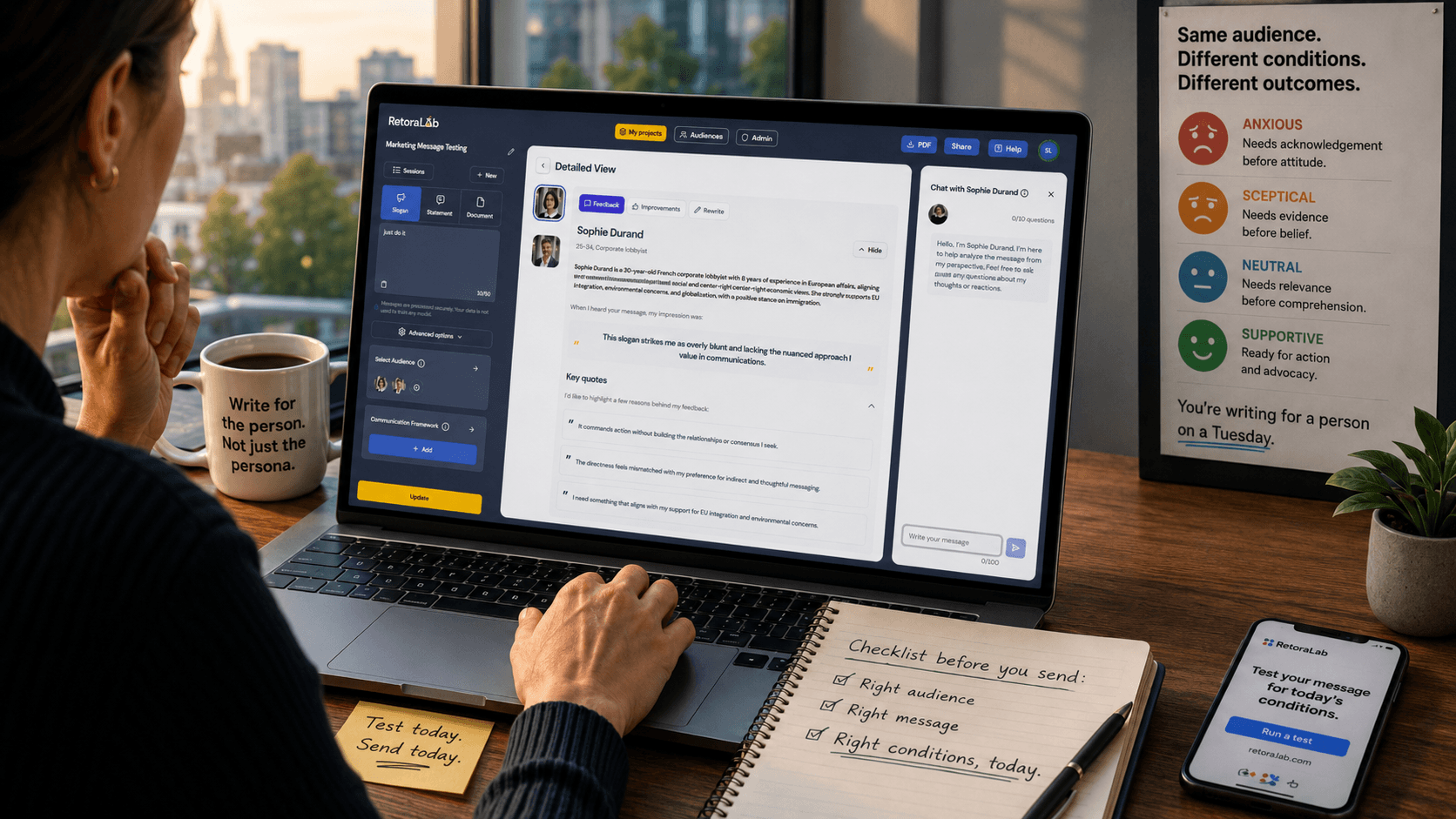
In March, a communications team at a mid-sized energy company tested a statement about grid investment. They ran it against their usual audience — pro-EU policy professionals, the cohort they'd built up over a year of campaigns. The scores came back strong. Confident, well-structured, persuasive. They filed it and moved on to the next thing on the list.
In June, with the campaign finally ready to launch, someone pulled the same statement back out before sending it. Same words. Same audience profile. They ran it again, mostly as a formality — a final check before going live.
The numbers had moved. Not collapsed, but shifted in a way that didn't make sense if you assumed this was the same group of people with the same views they'd had three months earlier.
Two different questions that look like one
A persona describes who someone is. Their values, their political orientation, their professional context, their institutional trust levels, what they care about. These things are durable. A pro-EU policy professional in Brussels doesn't become anti-EU between March and June. Their identity is stable in the way personalities are stable.
A persona is the climate — the long-run pattern, the thing you can describe in a profile and expect to hold for years. The condition is today's forecast — shaped by whatever has happened in that person's world over the last few weeks, and gone tomorrow whether or not anything you do changes it.
Most audience research captures climate brilliantly and weather not at all.
Why "Action" sometimes isn't available, no matter how good the message is
There's a framework called AMEC — widely used in public affairs measurement — that breaks communication outcomes into five stages: Awareness, Comprehension, Attitude, Action, Advocacy. Most teams pick one of these as the goal for a given message and write toward it. Get noticed. Make the position understood. Shift sympathy. Drive behaviour. Turn supporters into amplifiers.
You cannot ask an anxious audience to take Action. Not because the action is the wrong one, but because an anxious reader's first cognitive task is resolving the anxiety, not evaluating your request. Skip straight to "sign here, share this, attend this" with an audience that's currently anxious, and you don't get inaction — you get suspicion. The request reads as exploiting a vulnerability rather than addressing it.
An anxious audience needs Attitude work first. Acknowledgement. A sense that someone has actually noticed what they're worried about. Only after that does Action become something they're capable of considering.
This is true for all four conditions, and it's why the same five-stage framework produces completely different practical advice depending on what's happening in the room before you've said a word.
One sentence, four weather systems
Why a test from the planning phase doesn't survive to launch day
This is the part that should change how teams think about testing cadence, not just testing content.
A test run during campaign planning — weeks or months before launch — captures the audience's condition at that moment. If nothing in the world changes between testing and launch, the test still holds. But things change constantly, and almost none of those changes need to be about your message directly to shift the conditions the audience brings to whatever they read next.
An interest rate decision. A scandal involving an adjacent institution. A previous promise that quietly didn't get delivered last quarter. A bad week in the news cycle for the sector generally. None of these are about you. All of them change the weather your message arrives into.
By launch day, the test you ran in March is describing a weather system that has already moved on. The personas are exactly the same. The forecast isn't.
The shift this suggests
The shift isn't "test more messages." Most teams already feel like they're testing too much, too late, with too little time to act on what they learn.
You're not writing for a person. You're writing for a person on a Tuesday.
And Tuesday changes.
